top of page


Voir loin au XIXe siècle
 The showman, 1806. La lanterne magique, popularisée à travers l'Europe à partir du XVIIIème par les colporteurs, a longtemps été l'unique possibilité pour les populations de prendre connaissance de l'univers éloigné. Voir à ce sujet l'exceptionnelle collection iconographique réunie dans BALZER, R., Peepshows, A Visual History, Harry N. Abrams, Inc., New York, 1998. |  Au XIXe siècle, voir loin est d'abord un projet militaire, dont le portrait, réalisé par Horace Vernet, de Napoléon à Wagram, muni de sa lunette d'approche, peut être considéré comme l'image mythique. Le terme "observatoire" (qui, d'après le Petit Robert entre dans la langue française en 1667) prend au 19ème siècle un sens militaire "Lieu élevé, favorable à l'observation ou aménagé en poste d'observation. "Napoléon avait choisi pour observatoire une étroite croupe de gazon" (HUGO) |
|---|---|
 La lunette d'observation de Napoléon est tellement mythique qu'on la retrouve dans cette caricature de M. Thiers en Napoléon (1833), où elle constitue le complément emblématique du chapeau de l'Empereur. "La Caricature", no. 144. 1833 |  German advertisement for a "Fernseher" telescope (Leipzig, 1884). The German word "Fernsehen" was first used in 1890 by the physicist Eduard Liesegang (who published a work entitled "Beiträge zum Problem des electrischen Fernsehens" in 1891). Fernsehen became "fjer-syn" in Danish. The word "television" was proposed in 1900 by Constantin Perskyi. |
 "Seeing far" is a physical concept—of which the astronomical telescope is obviously the emblem—but it is also linked to the notion of anticipation. In the speculative work by Étienne Souvestre titled *Comment sera le monde* (adapted into Portuguese as *O que ha de ser o mundo no Anno tres mil*, Lisbon, 1859), the cast of characters includes not only a "Sir John Progresso" but also a "Sr. Telescopio." |  Significantly, a figure looking through a telescope appears in the very first drop cap of A. Robida’s novel *Le Vingtième Siècle* (Georges Decaux, Paris, 1883). As is well known, Robida was—after Georges du Maurier—the second graphic artist to envision the "telephonoscope," a precursor to television. |
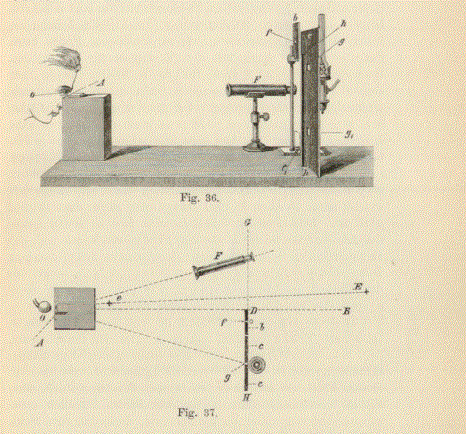 In the 1860s, Hermann von Helmholtz studied the physiology of the eye and designed an ophthalmometer. He used the term "Fernsehen" for "vision at a distance." |  Shooting position with E.-J. Marey's photographic gun. Document taken from E.-J. Marey, *Le Mouvement*, G. Masson, Paris, 1894. |
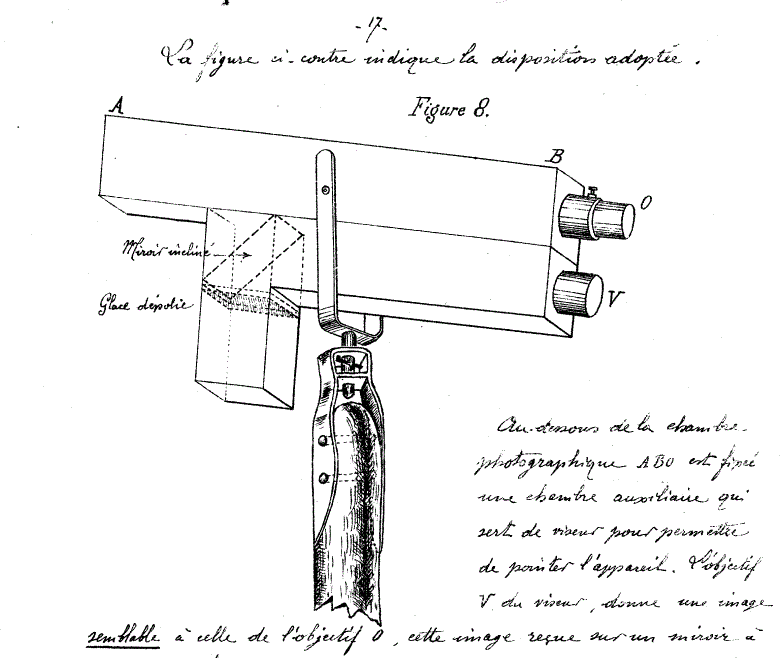 By the end of the 19th century, long-range photography had become a matter of military importance, as evidenced by a manuscript memorandum—held at the CNAM—by Battalion Commander Allotte de la Fuÿe, head of the Grenoble School of Military Engineering. | 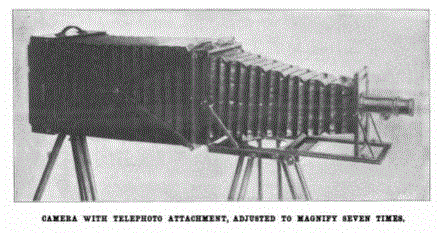 During the war between the United States and Spain over Cuba (1898), photographer Dwight L. Elmendorf took pictures of the fighting using a telephoto lens. A year later, *Scientific American* published an article on "telephotography." |
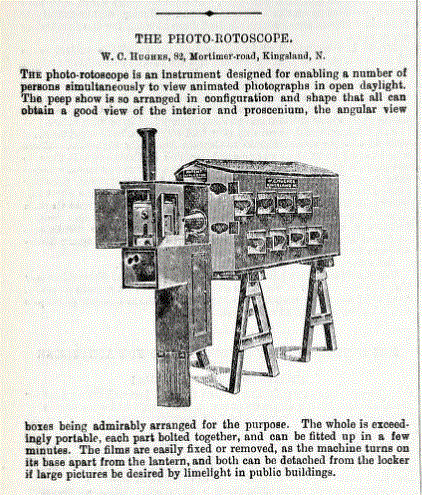 The Photo-Rotoscope (British Journal of Photography Supplement, May, 6, 1898) |


bottom of page